If someone had told me five years ago that people would be asking an AI to recommend a solicitor, an accountant or a kitchen company, I’d probably have laughed.
Yet here we are.
People don’t just use ChatGPT to write emails or help their kids with homework anymore. They’re asking it genuine buying questions. Things like, “Who’s the best family solicitor near me?” or “Can you recommend a good kitchen company?” They aren’t looking for ten blue links like they would on Google. They want one clear answer that saves them time.
Now here’s where it gets interesting.
On 6 June 2026, OpenAI officially launched ChatGPT Ads in the UK, making Britain the first European market where businesses can advertise inside ChatGPT conversations.
In my opinion, this is one of the biggest changes to online advertising we’ve seen in years. Not because it means Google Ads are finished. They aren’t. And not because every business should suddenly move its marketing budget across to ChatGPT. They shouldn’t.
It matters because this is a completely different way of reaching potential customers.
Google has always been brilliant at capturing demand. Someone types “divorce solicitor Tunbridge Wells” into Google because they’ve already decided they need a solicitor. Your job is to be there when they search.
ChatGPT is different.
Imagine someone asks:
“I’m getting divorced. We’ve got two children and I’m not sure where to start. How do I choose the right solicitor?”
That’s a very different conversation. The person hasn’t decided who to contact yet. They may not even know exactly what service they need. They’re still researching, still weighing things up and still looking for advice. That’s the point where trust starts to build, and it’s exactly where ChatGPT Ads come into the picture.
I’ve worked in digital marketing for nearly twenty years and one thing I’ve learnt is that successful advertising isn’t usually about shouting louder than everyone else. It’s about appearing at the right moment. Google Ads does that brilliantly when someone is ready to buy. ChatGPT has the potential to do it much earlier, while people are still trying to make sense of their options.
Does that mean Google Ads are suddenly obsolete? Absolutely not. Anyone claiming ChatGPT will replace Google is getting carried away. The two platforms solve different problems. One captures demand that already exists. The other has the potential to influence decisions before that demand fully develops.
That’s why businesses should be paying attention. Not because ChatGPT Ads are guaranteed to replace your existing marketing, but because they give you another opportunity to get in front of potential customers at a stage where, until now, advertising simply wasn’t possible.
If you’re wondering how ChatGPT Ads actually work, whether they’re similar to Google Ads, how businesses can advertise on the platform and whether they’re likely to be worth the investment, that’s exactly what this guide is here to answer.
Can You Actually Advertise on ChatGPT?
Yes, you can now, although that wasn’t always the case.
When I first heard OpenAI was introducing advertising, I assumed ChatGPT was going to end up looking like every other platform on the internet. You know the sort of thing: banners everywhere, sponsored results all over the page and adverts getting in the way of what you’re actually trying to do.
Thankfully, that’s not what they’ve done.
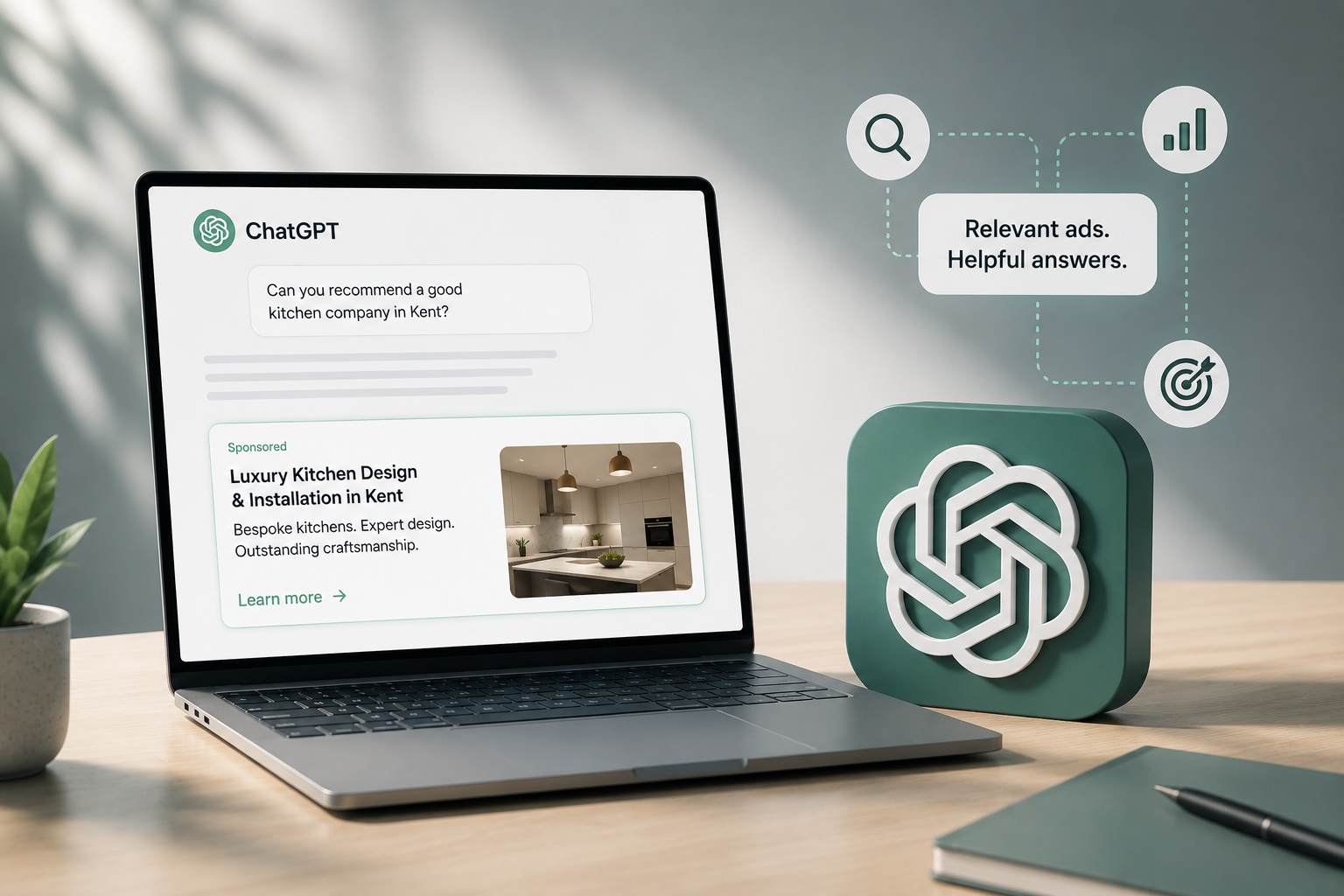
Instead, OpenAI has kept advertising separate from the conversation itself. The sponsored content is clearly labelled, which means you can still tell the difference between ChatGPT’s response and a paid placement.
Personally, I think that’s the right decision.
If people start questioning whether every recommendation has been influenced by advertisers, confidence in the platform disappears overnight. OpenAI knows that better than anyone, so it makes sense that protecting the user experience seems to have been the priority.
A lot of people also assume businesses have been advertising on ChatGPT for ages. They haven’t.
Until 6 June 2026, if somebody asked ChatGPT to recommend a solicitor, compare two accountants or suggest a kitchen company, there simply wasn’t an advertising platform available in the UK. Businesses could optimise their websites so AI systems were more likely to mention them, but they couldn’t actually pay to advertise within ChatGPT itself.
Now they can.
What I find particularly interesting isn’t the adverts themselves. It’s when they appear.
If someone asks ChatGPT something like:
“Can anyone recommend a family solicitor in Kent who specialises in child arrangements?”
They’re probably not ready to pick up the phone just yet. They’re still trying to understand their options.
That’s very different from someone typing family solicitor Kent into Google. One is asking for advice. The other is searching for a supplier.
That difference might sound small, but from an advertising point of view it’s huge.
How Are ChatGPT Ads Different from Google Ads?
This is probably the question I’ve been asked more than any other since ChatGPT Ads launched.
People naturally assume it’s just another version of Google Ads with a different name. On the surface, I can see why. They’re both advertising platforms, they’re both designed to generate enquiries and they’re both trying to put businesses in front of potential customers.
That’s pretty much where the similarities end.
The biggest difference isn’t the adverts themselves. It’s the mindset of the person using the platform.
When somebody opens Google, they’ve normally got a fairly clear idea of what they’re looking for. If they search for “emergency plumber Maidstone” or “Google Ads agency Kent”, they’ve already identified the problem and they’re actively looking for someone to solve it. They’re usually much closer to making a decision.
ChatGPT is often used much earlier.
People aren’t always looking for a company. Quite often, they’re looking for advice.
Imagine somebody asks:
“We’re thinking about extending our home. Is it worth investing in a new kitchen while we’re doing the work?”
At that point they aren’t choosing a kitchen company. They’re trying to work out whether it’s even the right decision.
Or perhaps somebody asks:
“I’m separating from my partner. Do I need a solicitor straight away?”
Again, they’re looking for guidance before they start comparing law firms.
Those conversations happen every day, but until now advertisers haven’t really had a way of reaching people at that stage of the journey. That’s what makes ChatGPT interesting.
It allows businesses to become visible while potential customers are still researching, asking questions and trying to make informed decisions. In marketing terms, that’s a very different opportunity from competing for someone who’s already searching for your service on Google.
Does that mean ChatGPT is better than Google?
No, and I don’t think it’s helpful to look at it that way.
If I needed an emergency electrician because my power had just gone out, I’d probably head straight to Google. I want somebody local, available and able to get to me quickly.
If I was planning a £40,000 kitchen renovation, choosing a financial adviser or looking for a solicitor to deal with a complicated family matter, I’d probably spend a lot longer researching before making a decision. That’s exactly the type of situation where ChatGPT is likely to become part of the process.
I don’t think businesses should be asking whether they need Google Ads or ChatGPT Ads. The better question is this:
Where are your customers making their decisions?
For some businesses, that’ll still be almost entirely on Google. For others, especially those selling higher-value services where trust and research play a big part, I think ChatGPT is going to become an increasingly important part of the customer journey.
That’s why I don’t see these platforms as competitors. I see them as two different ways of reaching the same customer at different stages of their decision-making process.
Which Businesses Should Be Advertising on ChatGPT?
This is where I’d be careful.
Whenever a new advertising platform launches, you’ll inevitably see people claiming it’s perfect for every business. Personally, I don’t think that’s true.
Just because you can advertise somewhere doesn’t automatically mean you should.
The first question I’d ask isn’t, “Can my business advertise on ChatGPT?” It’s, “Are my customers actually using ChatGPT before they buy?”
That’s a much more useful way of looking at it.
Let’s take two examples.
Imagine your washing machine floods the kitchen floor. You’re probably not going to spend half an hour asking ChatGPT for advice. You’re going to search Google for an emergency plumber, pick up the phone and get somebody out as quickly as possible.
Now compare that with someone planning a £30,000 kitchen renovation. They’re likely to spend weeks, if not months, researching different companies. They’ll compare styles, ask about materials, look at reviews, discuss budgets and try to understand what’s worth paying extra for before they ever contact a showroom.
Those are two completely different buying journeys.
The same applies to professional services. If someone has just received divorce papers, they might ask ChatGPT what the process involves, how finances are usually divided or whether they need a solicitor immediately. They’re gathering information before deciding who they want to represent them.
A business owner looking for an accountant may ask about changing from a sole trader to a limited company before they start comparing accountancy firms. Someone approaching retirement might ask whether they should speak to an independent financial adviser before they begin looking for one.
These are all situations where people naturally ask questions before making contact, which is exactly the type of behaviour ChatGPT has been built around.
In my opinion, the businesses most likely to benefit from ChatGPT Ads are those where trust, research and considered decision-making play an important part in the sale.
- Solicitors
- Accountants
- Mortgage brokers
- Financial advisers
- Estate agents
- Luxury kitchen companies
- Garden designers
- Architects
- Travel specialists
- Insurance brokers
- Marketing agencies
- High-end trades and home improvement companies
- Private healthcare providers
What all of these businesses have in common is that people rarely choose the first company they come across. They compare. They ask questions. They look for reassurance. They want to feel confident they’re making the right decision.
That’s where ChatGPT could become a valuable marketing channel.
Does that mean businesses selling lower-value products or services won’t benefit? Not necessarily. It’s just that I think the opportunity is likely to be strongest where the buying process naturally involves research, advice and trust.
If somebody is spending thousands of pounds or making an important life decision, they’re far more likely to have a conversation with ChatGPT before choosing who to contact.
How Does ChatGPT Know When to Show an Advert?
This is probably one of the biggest misconceptions about ChatGPT Ads.
A lot of people assume that because ChatGPT is powered by AI, it can read someone’s mind and decide exactly which advert to show. It isn’t that simple.
Just like Google, ChatGPT still needs to understand what the user is trying to achieve. The difference is that it has much more information to work with.
Let’s go back to a Google search for a moment.
If somebody searches for family solicitor Kent, Google has to work out what that person wants from just three words. Are they looking for legal advice? Are they ready to book an appointment? Are they comparing firms? Google has become incredibly good at interpreting search intent, but it’s still working from a relatively short search query.
Now compare that with someone asking ChatGPT:
“I’ve recently separated from my partner. We have two children and I think we’re going to disagree about where they live. Do I need a family solicitor, and how do I choose the right one?”
That’s a completely different level of detail.
The person has explained their situation, what they’re worried about and the type of help they’re looking for. ChatGPT has far more context than a traditional search engine would normally receive.
That’s one of the reasons many people believe conversational advertising has so much potential. It’s no longer just about matching a handful of keywords. It’s about understanding the conversation that’s taking place.
That doesn’t mean every conversation will trigger an advert.
If someone asks ChatGPT to explain how the solar system works or wants a recipe for lasagne, there’s no obvious commercial intent behind those questions. Showing adverts in situations like that wouldn’t make much sense and would probably create a poor experience for the user.
On the other hand, if somebody is asking for recommendations, comparing products, researching services or trying to decide which company to choose, that’s a very different type of conversation.
For example:
- “Can anyone recommend a good accountant for a small business?”
- “Which CRM is best for an estate agency?”
- “Who’s the best kitchen company in Kent?”
- “Should I choose SEO or Google Ads for my business?”
They’re all different questions, but they have one thing in common. The user is trying to make a buying decision.
That’s exactly where ChatGPT Ads are designed to fit.
For advertisers, that’s good news. It means the goal isn’t simply to get your advert in front of as many people as possible. It’s to appear in front of the right people, at the point where they’re actively researching a product or service and are genuinely interested in learning more.
What Do ChatGPT Ads Actually Look Like?
One of the first things I wanted to know was whether ChatGPT was about to become another Facebook.
Thankfully, it hasn’t.
If you’ve used Facebook or Instagram recently, you’ll know what I mean. You can barely scroll for more than a few seconds before another advert appears. Google isn’t much different. Search for almost anything with commercial intent and the first thing you’ll usually see is a row of sponsored results.
ChatGPT doesn’t feel like that.
The conversation still comes first.
If an advert is shown, it sits separately from the main response and is clearly marked as sponsored. You can immediately tell what’s part of ChatGPT’s answer and what’s paid advertising. That might not sound particularly exciting, but I actually think it’s one of the smartest decisions OpenAI has made.
Imagine asking ChatGPT to recommend a solicitor because you’re going through a divorce. Or asking which kitchen companies have the best reputation for high-end designs. You’re looking for help, not a page full of adverts.
If every response started feeling like a sales pitch, most people would stop trusting it.
That’s the balancing act OpenAI has to get right.
Businesses obviously want visibility, but users still expect honest answers. Lose either side of that equation and the platform quickly becomes less useful.
I also don’t think advertisers should expect ChatGPT to behave like social media.
People aren’t opening it to kill ten minutes while they’re waiting for a train. Most people have a reason for being there. They want an answer to a question, advice on a decision or help solving a problem. Once they’ve got what they came for, they’re usually gone.
From an advertiser’s point of view, that’s quite refreshing.
Instead of fighting for attention against holiday photos, cat videos and endless scrolling, you’re appearing alongside a conversation where somebody has already shown an interest in the subject you’re advertising.
To me, that’s a much healthier environment.
Will the platform change over time? Almost certainly. OpenAI will no doubt experiment with different formats as more advertisers come on board. That’s perfectly normal for a new advertising platform.
What I’d hope doesn’t change is the overall experience. The reason people enjoy using ChatGPT is because it doesn’t feel cluttered. If that changes, I think everyone loses — users and advertisers alike.
Will ChatGPT Ads Actually Generate More Enquiries?
That’s the million-pound question.
The honest answer is nobody knows yet. And if anyone tells you they do, I’d take it with a pinch of salt.
ChatGPT Ads have only just launched in the UK, so there aren’t years of case studies or mountains of performance data to analyse. We simply haven’t reached that stage yet.
That said, there are a few things we do know.
The first is that intent has always been one of the biggest factors behind a successful advertising campaign.
Think about the difference between somebody scrolling through Facebook on a Sunday evening and somebody actively asking ChatGPT for advice about choosing a solicitor, a mortgage broker or a kitchen company.
They’re in completely different mindsets.
One person is passing time. The other is trying to solve a problem.
As a digital marketer, I’d much rather speak to somebody who’s already thinking about making a decision than somebody who’s only half paying attention while watching videos on social media.
That’s one of the reasons I’m genuinely interested in ChatGPT Ads.
The platform isn’t trying to create demand in the same way Facebook or Instagram often does. It’s meeting people while they’re already researching a purchase, comparing options or trying to decide who they can trust.
If you’ve run Google Ads before, you’ll already understand how valuable that kind of intent can be.
Of course, intent on its own doesn’t guarantee results.
A poor advert is still a poor advert. A slow website is still a slow website. A confusing landing page will still lose enquiries.
ChatGPT Ads won’t magically fix any of those things. In fact, I’d argue they’ll expose them even more.
If somebody clicks your advert after having a detailed conversation with ChatGPT, they’ll arrive on your website with fairly high expectations. They’ll expect clear information, a professional-looking website and a good reason to choose your business.
If they don’t find those things, they’ll simply move on.
That’s why I don’t see ChatGPT Ads as something you bolt onto an average website and expect instant success. Like Google Ads, they’re only one part of the overall picture.
The businesses that are likely to get the best results are the ones with strong websites, clear messaging, genuine customer reviews and a straightforward way for people to get in touch.
So, will ChatGPT Ads generate more enquiries?
I think they will for the right businesses. Not because they’re powered by AI. Not because they’re new. But because they have the potential to put businesses in front of people at exactly the point where they’re trying to make an informed buying decision.
Whether that translates into more enquiries will still depend on everything that has always mattered in digital marketing: trust, relevance and a website that gives people confidence to take the next step.
How Do You Actually Advertise on ChatGPT?
If you’re expecting ChatGPT Ads to work exactly like Google Ads, you’ll probably be surprised.
At the time of writing, the platform is still very much in its infancy. OpenAI is gradually rolling out advertising to UK businesses, which means features, campaign options and reporting tools are likely to evolve over the coming months.
That said, the overall process is surprisingly familiar.
Just as you would with Google Ads or Meta Ads, you’ll need an advertising account, a billing profile, campaigns, adverts and somewhere for people to land after they click. The fundamentals of digital advertising haven’t suddenly changed because AI has entered the picture.
What has changed is the way businesses are matched with potential customers.
With Google Ads, campaign planning often starts with keyword research. You look at what people are searching for, decide which phrases you want to target and build campaigns around those searches.
ChatGPT turns that way of thinking on its head.
Rather than asking, “Which keywords should I bid on?”, a better question is:
“What conversations do I want my business to appear in?”
That might sound like a small difference, but it completely changes the way campaigns need to be planned.
Take a mortgage broker as an example.
A traditional Google Ads campaign might target searches such as mortgage adviser, buy-to-let mortgage or remortgage advice.
With ChatGPT, the starting point is likely to be very different.
You might want your business to appear when somebody asks:
“I’m buying my first home. Should I speak to a mortgage broker before I start viewing properties?”
Or perhaps:
“My fixed-rate mortgage ends in six months. Is it worth remortgaging now or waiting?”
Those aren’t keyword searches. They’re genuine questions people ask when they’re trying to make informed decisions.
That’s why I think businesses will need to think less like advertisers and more like their customers.
What questions are people asking before they become a client? What concerns do they have? What information are they looking for?
If you can answer those questions, you’re already thinking in the right direction.
The other thing that won’t change is the importance of your website.
No matter how good your advert is, the click is only the beginning. If somebody arrives on a slow website, struggles to find the information they need or isn’t given a clear next step, they’re unlikely to become an enquiry.
That’s no different from Google Ads, Meta Ads or any other advertising platform.
Technology changes. Human behaviour doesn’t.
People still want to know they’re dealing with a business they can trust.
For me, that’s probably the biggest takeaway from ChatGPT Ads so far. Yes, the technology is new. Yes, the way conversations are matched with advertisers is different. But the fundamentals of successful marketing remain exactly the same.
Businesses that understand their customers, answer their questions and make it easy for people to get in touch will almost always outperform those that simply chase the latest advertising platform.
Why Your Website Matters More Than Ever
There’s one mistake I can almost guarantee some businesses will make.
They’ll assume ChatGPT Ads are some sort of shortcut. They’ll think they can throw together an advert, send people to an average website and the enquiries will start rolling in.
I wouldn’t bank on it.
If anything, I think ChatGPT Ads raise the bar.
Think about what somebody has just done before they arrive on your website. They’ve already spent time asking questions. They’ve probably discussed different options with ChatGPT. They may have compared different approaches, learnt a little about the subject and narrowed down what they’re looking for.
In other words, they’re arriving far better informed than the average visitor.
That’s a good thing, but it also means they’re likely to be more selective.
If they click through to your website and find thin content, vague marketing claims or pages that don’t actually answer their questions, they’ll leave just as quickly as they arrived.
I’ve always said that successful advertising starts long before somebody clicks an advert. It starts with having a business people actually want to buy from.
A professional-looking website. Clear information. Real customer reviews. Examples of your work. Straightforward pricing where appropriate. Simple ways to get in touch.
None of that has changed. In fact, I’d argue it’s become even more important.
One thing I’ve learnt after managing paid campaigns for nearly twenty years is that the businesses generating the best results usually aren’t the ones with the biggest budgets. They’re the ones that build confidence quickly.
The visitor lands on the website and immediately thinks:
“These people know what they’re doing.”
That’s the reaction you’re aiming for.
Whether someone has come from Google, Facebook or ChatGPT doesn’t really matter. They’re still asking themselves exactly the same questions.
- Can I trust this business?
- Do they understand my problem?
- Am I in the right place?
If your website answers those questions within the first minute or two, you’ve already done something many businesses fail to do.
That’s why ChatGPT Ads are not a replacement for good marketing. They’re another opportunity to introduce your business to the right people.
Everything that happens after the click is still down to you. And, in my experience, that’s where campaigns are won or lost.
If your website needs improving before you invest in paid traffic, that’s something worth addressing first. A well-built, conversion-focused website will help every channel perform better, whether that traffic comes from Google, Meta, ChatGPT or your wider website marketing strategy.
How Much Do ChatGPT Ads Cost?
This is probably the one question everyone wants answered.
The truth is, nobody can give you a definitive answer yet.
That’s not me avoiding the question. It’s simply because ChatGPT Ads are still in their early days, and OpenAI hasn’t reached the point where there are years of pricing data, average cost-per-click figures or industry benchmarks to compare.
If you search online, you’ll find people confidently predicting what clicks will cost or what return on investment businesses should expect. Personally, I’d ignore most of it.
It’s too early.
If there’s one thing I’ve learnt from nearly twenty years of managing PPC campaigns, it’s that the cost of advertising is only half the story anyway.
Let’s say someone told you a click on ChatGPT costs £8.
Is that expensive?
Well… it depends.
If you’re a local café selling £3 coffees, probably.
If you’re a solicitor handling divorce cases, a financial adviser arranging pensions or a kitchen company installing £40,000 kitchens, it suddenly doesn’t sound expensive at all.
I’ve seen businesses worry about paying £10 for a click while happily spending thousands on magazine adverts that generate no measurable enquiries whatsoever.
Context matters.
What really matters isn’t the cost of the click. It’s the cost of acquiring a customer.
That’s a figure every business should know, regardless of whether they’re advertising on Google, Facebook or ChatGPT.
If you spend £500 on advertising and it generates a £15,000 kitchen project, most business owners wouldn’t lose any sleep over the advertising costs.
On the other hand, spending £50 to generate no enquiries at all is expensive.
That’s why I always encourage clients to look beyond the headline figures.
Don’t ask:
“How much does a click cost?”
Ask:
“If this platform brings me the right enquiries, what’s a new customer actually worth to my business?”
That’s a much more useful conversation.
As the platform matures, we’ll undoubtedly see more pricing data, more case studies and a much clearer picture of what businesses can expect to pay.
Until then, I’d be cautious about anyone claiming they already have all the answers.
The businesses that are likely to benefit most over the next year won’t necessarily be those with the biggest budgets. They’ll be the businesses willing to test, measure the results and make decisions based on real data rather than speculation.
That’s exactly how every successful advertising platform has evolved, and I don’t expect ChatGPT Ads to be any different.
Should You Start Advertising on ChatGPT Now?
If you’d asked me that question a week after the platform launched, I’d probably have been a bit more cautious.
New advertising platforms nearly always go through a settling-in period. Features change, reporting improves and advertisers gradually work out what works and what doesn’t.
That said, I do think there’s an advantage to getting involved early.
Not because you’ll magically get cheaper clicks or less competition. Nobody knows whether that’ll happen.
The real advantage is experience.
Every advertising platform has a learning curve.
When Google Ads first launched, businesses that took the time to understand it early had a significant head start over those who ignored it for a few years. The same thing happened with Facebook Ads.
I suspect ChatGPT Ads will be no different.
That doesn’t mean I think every business should move its advertising budget tomorrow. Far from it.
If you’re already running profitable Google Ads campaigns that consistently generate enquiries, I wouldn’t be rushing to switch budget away from something that’s already working.
Personally, I’d treat ChatGPT as an additional marketing channel rather than a replacement.
Start small. Measure the results. See what type of enquiries it generates. Then decide whether it deserves a larger share of your marketing budget.
That’s a much lower-risk approach than going all in simply because the platform is new.
I’d also think carefully about whether your business is actually ready.
Do you have a website that builds trust? Can people quickly understand what you do? Is it obvious why somebody should choose you instead of a competitor?
If the answer to those questions is no, I’d spend time fixing those issues first.
Advertising can bring people to your website. It can’t make them trust your business.
One thing I’ve noticed over the years is that businesses often spend a lot of time asking which advertising platform they should use, when the better question is whether they’re ready to advertise in the first place.
Sometimes improving the website, adding customer reviews or making it easier for people to enquire has a bigger impact than changing where the traffic comes from.
So, should you start advertising on ChatGPT?
If your business relies on customers researching before they buy, I think it’s definitely worth exploring.
Just don’t make the mistake of thinking it’s a silver bullet. Treat it the same way you would any other marketing investment. Test it properly, measure the outcome and let the data tell you whether it’s right for your business.
That’s how good marketing decisions have always been made, and I don’t think AI changes that.
What Does This Mean for the Future of Digital Marketing?
One thing I can say with confidence is this: I don’t think ChatGPT Ads are going to kill Google Ads.
I’ve seen plenty of headlines suggesting AI is the end of search engines. Personally, I think that’s an oversimplification.
Google still has a huge role to play.
If I need an emergency locksmith because I’ve locked myself out of the house, I’m not opening ChatGPT. I’m grabbing my phone, searching Google and ringing the first reputable company I find.
That isn’t going to change anytime soon.
Where I do think things are changing is the research stage.
People are becoming much more comfortable asking AI for advice before they make a purchase. Whether they’re choosing a solicitor, comparing kitchen companies or deciding which CRM to buy, they’re increasingly starting with a conversation rather than a search.
That’s a behavioural shift rather than a technological one.
As marketers, we’ve always followed customer behaviour.
When people started using smartphones, websites had to become mobile-friendly. When social media exploded, businesses had to decide whether they wanted a presence on Facebook and Instagram.
Now we’re seeing the same thing happen with conversational AI.
I don’t think the winners over the next few years will be the businesses that abandon Google in favour of ChatGPT. I think they’ll be the businesses that understand how the two platforms work together.
Some customers will still search. Others will ask questions. Some will discover your business through Google. Others may first hear about you through ChatGPT before later searching for your company name, reading your reviews and visiting your website.
The customer journey is becoming less predictable, and that’s something every business owner needs to recognise.
That’s why I don’t see ChatGPT Ads as just another advertising platform. I see them as part of a much bigger shift in how people discover businesses online.
Whether it’s ChatGPT today or another AI platform tomorrow almost doesn’t matter. The important thing is understanding where your customers are spending their time and making sure your business is visible when they’re ready to make a decision.
For me, that’s the biggest takeaway from all of this.
The technology will continue to evolve. Advertising platforms will come and go. But businesses that adapt to changing customer behaviour have always been the ones that stay ahead.
I don’t see any reason why this time will be any different.
ChatGPT Ads Are Only Part of the Picture
One thing I’d be careful of is putting all your focus on advertising.
Yes, ChatGPT Ads are exciting, and I genuinely think they’ll become an important marketing channel for many businesses. But they’re only one way people can discover your business through AI.
The other way is completely free.
Think about it for a moment.
If somebody asks ChatGPT:
“Who are the best kitchen companies in Kent?”
or:
“Can you recommend a good SEO agency?”
There won’t always be an advert. Sometimes ChatGPT will simply answer the question.
That’s where things become really interesting.
As well as helping businesses advertise, we’re also seeing the rise of something called Generative Engine Optimisation, often shortened to GEO. It’s still a relatively new term, but the idea behind it is straightforward.
Instead of optimising your website purely for Google, you’re also making it easier for AI platforms such as ChatGPT to understand your business, your expertise and the services you provide.
Personally, I think every business should be thinking about both.
Paid advertising gives you immediate visibility. Organic visibility helps you build long-term authority.
The two work exceptionally well together.
It’s actually very similar to the advice I’ve given clients for years. I never tell businesses to rely entirely on Google Ads. I also wouldn’t tell them to rely entirely on SEO.
The strongest marketing strategies nearly always combine both. One generates enquiries today. The other builds visibility for tomorrow.
I think AI search will develop in exactly the same way.
Some businesses will advertise. Others will focus on improving their organic visibility. The businesses that really stand out are likely to invest in both.
That’s certainly the approach we’re taking at RankFresh.
We’re continuing to help businesses generate enquiries through Google Ads and Meta advertising, while also helping them prepare for the way people are increasingly searching through AI.
Because whether somebody discovers your business through a paid advert or an organic recommendation, the end goal is exactly the same: to be visible when the right customer is looking for you.
Ready to See if ChatGPT Ads Are Right for Your Business?
If you’ve made it this far, you’re probably asking yourself one simple question:
Could ChatGPT Ads generate enquiries for my business?
The honest answer is… it depends.
Some businesses will see huge potential. Others will be better off sticking with Google Ads or investing in SEO until the platform matures. That’s why I don’t believe in selling the latest trend just because it’s new.
At RankFresh, we’ll give you honest advice based on your business, your industry and your goals. If I think ChatGPT Ads are worth testing, I’ll explain why. If I don’t, I’ll tell you that as well.
Whether you’re a solicitor, accountant, kitchen company, estate agent, travel business or another service-based company, I’d be happy to look at your current marketing and discuss whether ChatGPT Ads deserve a place in your strategy.
Book Your Free ChatGPT Ads Strategy Session
During your free, no-obligation strategy session, we’ll discuss whether ChatGPT Ads are a good fit for your business, how they compare with your current Google Ads and SEO strategy, the type of conversations your business could appear in, what you should be doing now to prepare for AI-powered search, and the next steps if you decide to become an early adopter.
There’ll be no hard sell and no marketing jargon. Just practical advice from someone who’s spent nearly twenty years helping businesses generate more enquiries online.
If you’d like to explore what ChatGPT Ads could mean for your business, get in touch with RankFresh today.
We’d love to help you stay one step ahead as the next generation of digital advertising begins.