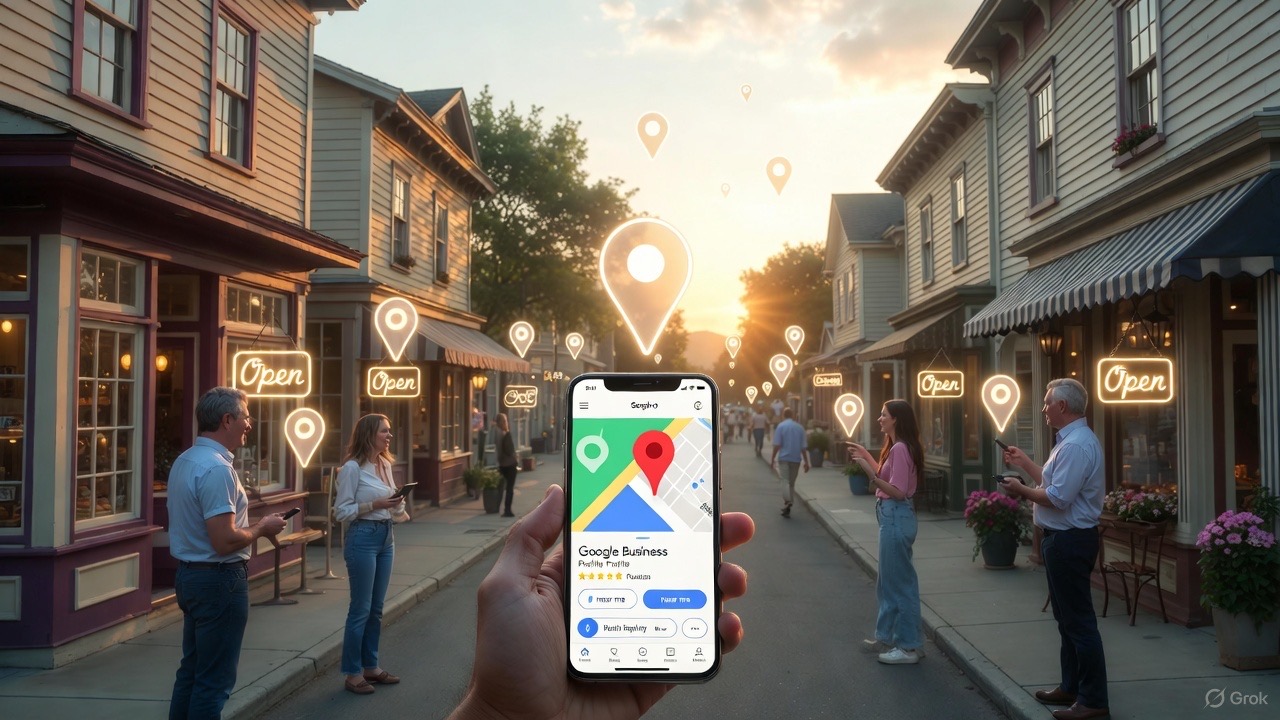
Local SEO in 2026 is a different game to what most small businesses think they are playing.
People are not just typing a few words into Google and scrolling through ten blue links anymore. They are asking AI tools questions, checking Google Maps, searching on TikTok, and trusting what they see in reviews and social feeds long before they land on your website.
If you run a small or medium business in the UK, you are not simply “trying to rank on Google”. You are trying to show up in three key places:
- Google Maps and the Local Pack
- AI Overviews and LLM answers in tools like Google, ChatGPT, Perplexity and others
- The short list of brands people see on review sites and social platforms
This guide is about how to do that properly. No tricks, no loopholes, no risky tactics that get wiped out in the next update. Just practical, ethical local SEO that a real business owner can understand and implement.
If you want more background before diving in, you can also read my article on
local SEO tips for small businesses
and my overview on
how to do SEO for your small business.
The foundations of local SEO that still matter in 2026
Google still leans on three core local ranking factors: proximity, relevance, and prominence.
You cannot control proximity. If someone searches for “plumber near me”, Google knows where they are and will favour businesses physically close to them. What you can control is how relevant and how prominent you look in your space.
Get your NAP consistency sorted
NAP stands for name, address, and phone number. For local SEO in 2026, this must be consistent across:
- Your website
- Your Google Business Profile
- Key directories and platforms like Yelp, Trustpilot, Facebook, and any sector-specific sites
If you have different phone numbers, slightly different business names, or outdated addresses out in the wild, Google has to guess. When Google has to guess, you lose trust and rankings.
Cleaning this up is one of the quickest wins in local SEO. If you want a structured way to tackle it, have a look at my
on-site SEO checklist for small businesses.
Build a site that is actually local-friendly
Your website still matters. A lot. AI tools and search engines read it to understand what you do, who you help, and where you operate.
At a minimum you need:
- A fast, mobile-friendly site that loads cleanly on 4G
- Clear copy that spells out what you do, where you do it, and who you serve
- Dedicated service pages instead of one vague “Services” page
- Location pages where it makes sense, not just a list of towns in the footer
If a human cannot tell in ten seconds what you offer and which area you cover, neither can Google or an AI assistant.
If you are thinking of redesigning or rebuilding your site, read this first so you do not wreck your SEO by accident:
website redesign or replatforming – how to avoid nuking your SEO.
Google Business Profile: your real homepage for local search
For local businesses, your Google Business Profile is often your real homepage. People see it before they ever see your website. It heavily influences your Google Maps ranking and Local Pack visibility.
If you have not claimed and verified your profile yet, that is the first job. Once that is done, you optimise it properly.
The key Google Business Profile elements that matter in 2026
- Primary and secondary categories: choose the most accurate primary category and then add relevant secondary ones. This directly impacts which searches you appear for.
- Attributes: things like wheelchair access, payment methods, women-led, online appointments. They help match you to more specific searches.
- Opening hours: keep them updated. Do not forget bank holidays and seasonal changes. Inconsistent hours damage trust.
- Products and services: add structured lists with clear descriptions and pricing where possible.
- Booking links and URLs with UTMs: add booking links, menu links, or “learn more” links and track them using UTM tags so you can see which clicks turn into leads.
- Photos and videos: upload real photos of your premises, team, and work. Short vertical videos work well for both users and AI-driven results.
- Posts, offers, and events: post regularly. Treat GBP like a mini social feed. Activity helps show you are alive and engaged.
- Messaging and Q&A: if you can respond quickly, enable messaging. Answer every Q&A clearly and reuse common questions on your website.
If you want to go deeper into common pitfalls, check out
nine common reasons your Google Business Profile gets suspended. It will show you what to avoid while you are optimising.
For a more Map Pack focused approach, I have also broken down practical steps in
nine steps to show up on Google Maps and clean up on local traffic.
Reviews and reputation: your strongest trust and conversion signal
In local search, your reviews are your social proof, your conversion tool, and your ranking signal all rolled into one.
Google, AI Overviews, and tools like ChatGPT look at:
- How many reviews you have
- How recent they are
- Your average rating
- How you respond to them
If you only have a handful of old reviews and you never reply, you will struggle to compete with a similar business that has fresh reviews every week and a clear owner voice in the replies.
I have a full guide on this at
mastering online reviews in 2025, but here is the simple version.
Build a simple review engine
- Ask at the right time: right after you complete the job, deliver the service, or when the customer is clearly happy.
- Make it easy: send a direct link via email, SMS, WhatsApp, or use QR codes on receipts or thank-you cards.
- Prioritise the right platforms: Google first, then sector-specific sites like Checkatrade, Houzz, Tripadvisor, Treatwell, or Trustpilot depending on your industry.
- Reply to every review: thank them, address any details, and where natural, add a bit of context such as the service and location without stuffing keywords.
Example response:
“Thanks so much for the review, Sarah. It was a pleasure helping you with your kitchen renovation in Tunbridge Wells. If you ever need help with the new lighting or appliances, you know where we are.”
That one response gives Google and AI tools details about service type and location while sounding natural to humans.
A clear warning: never pay for fake reviews, never bulk import reviews from other platforms, and never “gate” reviews by only inviting happy customers. If you want to understand why that is risky, read
my guide to spotting SEO spam and scams. Google’s spam policies are very clear and the penalties hurt.
Content for AI search: make your site LLM friendly
AI Overviews and large language models pull from websites, reviews, profiles, and structured data. They like clear, detailed, human content that answers specific questions.
The trick is to turn the conversations you already have with customers into content.
Turn real questions into content ideas
Think about the questions you get by phone, email, and WhatsApp every week:
- “How do I choose the right [service] near me?”
- “Is [treatment] safe if I have [condition]?”
- “What should I do if [problem] happens?”
- “Roughly how much does [job] cost in [area]?”
Every one of these can become a page, a blog post, a deep FAQ entry, or even a short guide.
What to build in 2026
- Deep FAQ sections: group questions by topic and intent. Do not just stick one token FAQ block at the bottom of a page.
- Problem and use case content: create “what to do if” articles that mirror how people ask for help in real life.
- Detailed service pages: explain what happens step by step, who it is for, what it costs, how long it takes, and what the risks or limitations are.
- Internal linking: connect relevant pages so Google and AI tools can see how topics and locations relate to each other.
If you want to go further into the AI side of this, read my piece on
how to get found on LLMs and my article on
optimising for AI chatbots as well as search engines. Together they show how this content gets picked up in AI answers.
Hyperlocal content and proof: show you are the expert in your patch
Hyperlocal content is becoming a serious ranking factor in both classic local SEO and AI-driven results. It proves you are not just a generic business; you are embedded in a specific place.
Hyperlocal content formats that work
- Neighbourhood and area pages: not keyword-stuffed lists of towns, but real guides that talk about the area, the type of properties or people there, and how your service fits into their lives.
- Case studies linked to actual places: “loft conversion in Sevenoaks”, “garden redesign near Blackheath”, “clinic fit-out in Shoreditch”. Use photos and real stories.
- Local guides: pieces like “what it is like working with a dog trainer in South London” or “how to prepare your home for a deep clean in Brighton”.
- Testimonials with context: build a testimonials page where reviews mention specific services and locations, instead of just dumping screenshots from your Google profile.
If you want a content-led angle on this, especially if you are in trades or construction, take a look at
improving SEO through blogging for local construction businesses. The principles apply across most local industries.
For more local visibility ideas, my guide on
how to get found in “near me” searches ties in nicely with this approach.
Links and brand mentions: real world signals, not gimmicks
Links still matter in 2026, but the way you earn them as a local business is different to a national e-commerce brand. For local SEO it is less about chasing huge domain ratings and more about earning relevant, real-world signals.
Legit ways to build local authority
- Sponsor local clubs, charities, and events: not just for the link, but because it roots you in the community. You want your logo on their partners page, your name in their recap posts, and your team in the photos.
- Get involved in local stories: if you launch a new service, create jobs, support a community project, or win an award, that can be a genuine local PR story.
- Pitch to the right outlets: think local papers, community blogs, industry sites, and podcasts. Avoid mass syndication and link farms.
Be very clear about what to avoid:
- PBNs (private blog networks)
- Link schemes and bulk link buying
- Fake “.org” charity fronts
- Over-optimised anchor text that looks unnatural
Search engines and AI systems are extremely good at spotting this kind of activity now. If you want a sense of what modern spam looks like from a mile away,
my guide to spotting SEO spam and scams walks through it in detail.
If you are interested in how AI systems interpret these signals, my article on
generative engine optimisation (GEO) digs into how AI search experiences use brand mentions and context, not just links.
Schema and structured data: fuel for Maps, AI Overviews, and rich results
Schema is a structured way of telling search engines and AI systems what your business is, what you offer, and how everything connects. It is invisible to your visitors but very visible to machines.
As AI Overviews and LLMs summarise more information on the fly, having clean schema makes it easier for them to trust and reuse your content.
Schema types local SMEs should prioritise
- LocalBusiness or Organisation: including your name, address, phone number, geo coordinates, opening hours, and links to your profiles.
- Service and Product: describing what you offer, who it is for, and how it helps.
- FAQPage: for pages that genuinely answer multiple questions.
- HowTo: for step-by-step guides where you walk people through a process.
- Review and AggregateRating: to reflect your real reviews if you have them.
Never fake review numbers or stuff schema with made-up information. It is easier than ever for Google to cross check that data with your real profiles and reviews.
If you want a simple starting point, read
why schema markup is the easiest SEO win you are not using yet. It breaks down exactly how to implement it without needing to be a developer.
Local visibility is bigger than Google now
Google is still the heavyweight, but it is not the only place people look for local businesses.
In 2026, people might find you via:
- Google Search and Google Maps
- Apple Maps and Siri
- Social search on TikTok and Instagram
- AI assistants like ChatGPT and Perplexity
- Niche review and booking platforms in your sector
Where SMEs should actually focus
- Major map providers: claim and clean up your listings on Google Maps and Apple Maps. Make sure the data is accurate and consistent.
- Niche platforms: depending on your sector this might be Checkatrade, Houzz, Tripadvisor, Treatwell, Trustpilot, or others. Pick the ones that genuinely send you customers.
- Short-form video: use TikTok, Instagram Reels, or YouTube Shorts to show your work, answer common questions, and demonstrate your process.
This multi-platform presence sends strong brand signals that AI tools and search engines can join together. If you want to understand how AI fits into all of this,
my guide to digital marketing, SEO, and AI in 2025 lays out the bigger picture.
Behaviour signals, UX, and conversion: what happens after the click
Getting found is half the battle. Being chosen is the other half. Behaviour signals are one of the ways search engines and AI systems figure out whether you are actually useful.
They look at things like:
- Click-through rates from search results
- How long people stay on your pages
- Whether they bounce straight back
- How often they tap for directions or calls
If people keep clicking on your result and then quickly backing out, it is a sign that something on your site is not working.
What SMEs must fix on their sites in 2026
- Page speed: slow sites still lose rankings, conversions, and patience. If your site drags, so do your leads. You can run a quick check with my
site speed checker. - Mobile UX: most local visitors will find you on a phone. Make sure the layout is stable, text is readable, and buttons are big enough to tap.
- Above-the-fold clarity: the top of your page should instantly answer three questions: what do you do, where do you do it, and why should I trust you.
- Obvious next steps: calls to action should be blunt and simple: call now, book an appointment, request a quote, send a message.
For a deeper dive on turning traffic into leads, read
twelve website optimisation tips to turn visitors into leads and
what makes a killer PPC landing page. The principles apply to local SEO just as much as paid traffic.
On the analytics side, make sure your reporting is not misleading you.
This piece on GA4 and ad reports explains where things can go wrong.
Smart use of AI tools without losing the plot
AI tools are brilliant at speeding up grunt work, but they are not a replacement for strategy or judgment. Local SEO still needs a human brain steering the ship.
Good ways for SMEs to use AI in 2026
- To mine customer emails, chats, and reviews for content ideas and FAQs
- To generate first drafts of blog posts, FAQs, and service pages, which you then edit heavily
- To suggest internal links between your pages
- To generate alt text and basic schema, which you then check before publishing
Bad ways to use AI for local SEO
- Auto-generating hundreds of thin city pages that all say the same thing
- Building doorway sites whose only job is to funnel traffic
- Mass-producing content with no quality control or fact-checking
- Using AI to fake reviews, testimonials, or case studies
- Spinning up fake GBPs just to dominate the map results
These are the kinds of things that may work for a month and then get wiped out by a spam update. My article
how AI is revolutionising digital marketing and my piece
ten AI prompts small businesses can use give you better ways to use AI without stepping into dangerous territory.
If you are tempted to lean too hard into AI content,
read this before you do. Your customers care more than Google does.
A 90-day action plan for local SMEs
Here is how to turn all of this into a focused local SEO plan for the next 90 days.
- Fix your Google Business Profile and NAP consistency: claim and optimise your GBP, then align your name, address, and phone details across your site and key directories.
- Put a review engine in place: decide when and how you will ask for reviews and which platforms matter most for you.
- Refresh your service and location pages: build or improve pages with clear copy, deep FAQs, and at least a couple of case studies or testimonials.
- Implement essential schema: add LocalBusiness, Service, FAQPage, and Review schema to the key pages.
- Secure 5 to 10 real local links or mentions: focus on charities, clubs, partners, local press, and industry sites that genuinely connect with your business.
- Clean up UX and tracking: improve page speed, simplify your calls to action, and make sure you can track calls, forms, messages, and bookings properly.
You do not need to chase every shiny new SEO trick to win in local search. If you do these fundamentals well, you will naturally begin to show up in Google Maps, AI Overviews, and AI-powered tools when people in your area go looking for what you do.
If you want a second pair of eyes on your local SEO and website, I am happy to help.
Book a free website review and I will walk you through what is working, what is holding you back, and what to fix first to start getting found by the right people.